If you’ve ever wondered what a dental implant actually is, the simplest way to think of it is as a brand-new, artificial tooth root. It’s the modern gold standard for replacing a missing tooth, surgically placed into your jawbone to create a permanent, incredibly secure foundation for a replacement tooth that looks, feels, and functions just like the real thing.
What Is a Tooth Implant and How Does It Work?
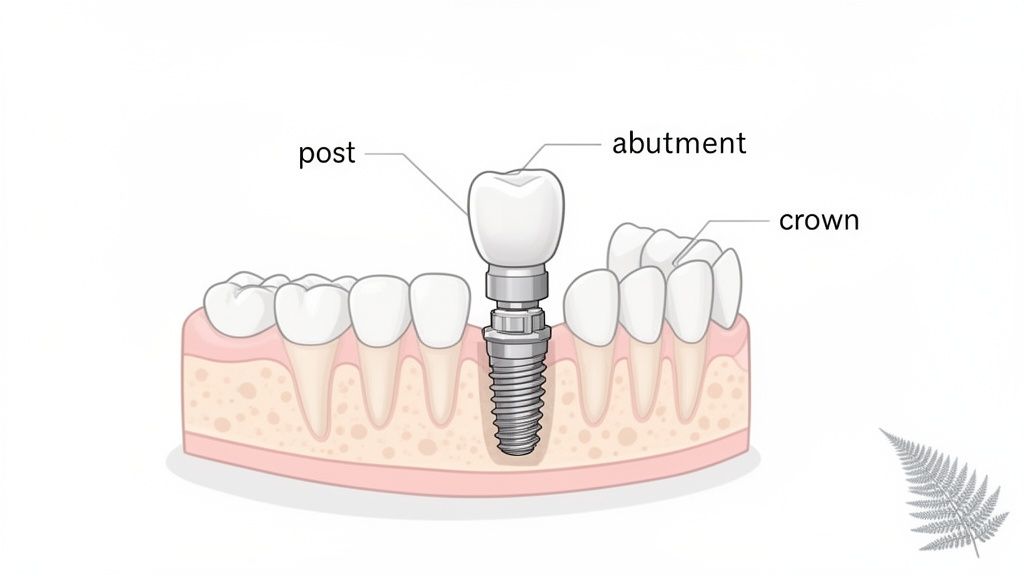
When you lose a tooth, it's not just the visible part that disappears—the root anchoring it in your jaw is gone too. This is a bigger deal than it might seem. A dental implant is the only solution designed to replicate the entire tooth structure, from root to crown. Think of it like the piles of a house; it provides a level of deep stability that other options like bridges or dentures simply can't match.
It’s this unparalleled stability that has made dental implants the go-to long-term solution for missing teeth right across New Zealand. They aren’t just designed to plug a gap. They’re engineered to fully integrate with your body, which helps preserve your jawbone and stops neighbouring teeth from drifting into the empty space. This holistic approach restores both the aesthetics of your smile and the full function of a natural tooth.
It’s no surprise that the demand for this kind of permanent tooth replacement is on the rise. In fact, the dental implants market for Australia and New Zealand was valued at USD 241.28 million in 2023 and is expected to reach nearly USD 340 million by 2030. Part of this is driven by Kiwis looking for lasting, high-quality solutions for tooth loss. If you're interested in the numbers, you can dive deeper in this recent industry report from Grandview Research.
The Three Parts of a Dental Implant
A complete dental implant isn't one solid piece. It’s actually a sophisticated three-part system, with each component playing a vital role in rebuilding your tooth with incredible strength and a natural look.
The Three Parts of a Dental Implant
| Component | Material | Function |
|---|---|---|
| The Implant Post | Medical-Grade Titanium | The "root." This screw-like post is gently placed into the jawbone, where it acts as the powerful new anchor. |
| The Abutment | Titanium or Zirconia | The "connector." This small piece attaches to the post, sitting just above the gum line to connect the implant to the crown. |
| The Crown | Porcelain or Ceramic | The "tooth." This is the visible part, custom-made to perfectly match the colour and shape of your surrounding teeth. |
Each part is designed to work in harmony, creating a final result that is virtually indistinguishable from a natural tooth.
The Science of Osseointegration
So, what’s the secret sauce that makes an implant so strong? It all comes down to a natural biological process called osseointegration. It sounds complicated, but the idea is actually quite straightforward.
Once the titanium post is placed in your jaw, your body doesn't reject it. Instead, your jawbone naturally grows around and fuses directly onto the implant's surface.
Because titanium is biocompatible, the body essentially recognises it as part of itself. This fusion creates a rock-solid, permanent bond that won't slip or shift when you're eating, talking, or laughing—giving you total confidence.
This remarkable process is exactly why a tooth implant in NZ is considered the most reliable and long-lasting way to replace a missing tooth. It truly becomes a part of you, helping to maintain your facial structure and protecting your overall oral health for years to come.
Your Dental Implant Journey From Start to Finish
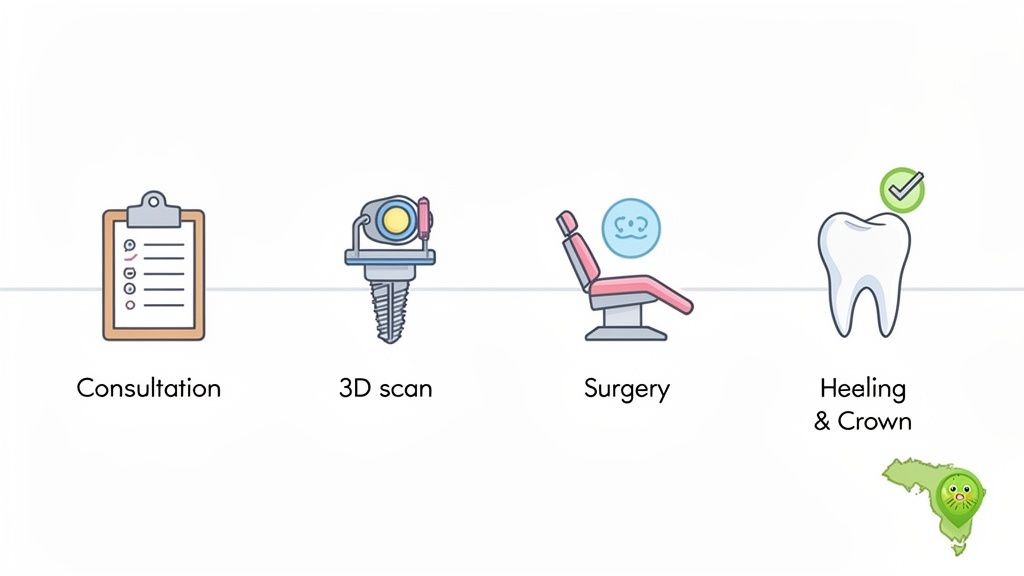
Getting a dental implant isn’t a one-and-done appointment; it's a carefully planned journey. Knowing what to expect at each stage helps take the mystery out of it all, giving you the confidence to move forward. Think of it as a genuine partnership between you and your dental team, where every step is designed for a predictable and comfortable result.
It all starts with a simple conversation. The initial consultation is our chance to sit down, listen to what you want to achieve, go over your medical history, and have a good look at your oral health. This is where we make sure we're building your new smile on solid ground.
To get the full picture, we use advanced 3D imaging, typically a Cone Beam Computed Tomography (CBCT) scan. This gives us an incredibly clear, detailed view of your jawbone, nerves, and surrounding teeth, allowing us to plan everything with pinpoint accuracy.
Step 1: Collaborative Treatment Planning
With all the information gathered, we'll map out your personalised treatment plan. This isn't a lecture; it's a chat where we walk you through your options, explain the timeline, and break down the costs. Your goals are our priority, so the final result is exactly what you had in mind.
This is also when we figure out if any groundwork is needed. For an implant to last a lifetime, it needs a strong foundation. If your jawbone has lost some density—which is quite common after a tooth has been missing for a while—we might need to do a preliminary procedure.
For instance, a bone graft can help rebuild the area, creating the perfect anchor point for the implant post. If this is part of your plan, we'll explain it all clearly. You can learn more about the bone grafting process and how it sets you up for a successful tooth implant in NZ.
Step 2: The Implant Placement Surgery
The next phase is the placement of the titanium implant. We know this can sound a bit intimidating, but your comfort is our absolute focus. The procedure is done under local anaesthetic, so the area will be completely numb, and you won’t feel any pain.
If you’re feeling particularly anxious, we have sedation options available to help you totally relax during the appointment. The process itself is surprisingly gentle; your dentist carefully creates a small space in the jawbone and places the implant. Most people find the experience far less eventful than they imagined, often saying it was easier than getting a filling.
The world of dental implants in New Zealand is always moving forward, with a real focus on patient care and new technology. Innovations like zirconia implants (for excellent biocompatibility) and AI-guided diagnostics are making surgeries smoother and more precise. For Kiwis needing urgent solutions, these developments often mean faster, more comfortable visits. In fact, a growing number of clinicians in Australia and New Zealand are now using computer-assisted guided placement to improve accuracy. You can discover more insights about these ANZ market trends on archivemarketresearch.com.
Step 3: Healing and Osseointegration
Once the implant is placed, a really important healing period begins. This is when a remarkable natural process called osseointegration happens—your jawbone literally grows around and fuses with the titanium post. This fusion is what creates that incredibly strong, permanent foundation for your new tooth.
This healing phase typically takes three to six months. It definitely requires a bit of patience, but it’s the most critical part of the entire journey. It’s what ensures your implant becomes a stable, permanent part of your jaw.
During this time, we might place a temporary tooth or a small healing cap over the site to protect it. We'll keep a close eye on your progress to make sure everything is healing perfectly before we move on to the final stage.
Step 4: Attaching the Abutment and Crown
Once osseointegration is complete, you’re on the home stretch. First, we attach a small connector called an abutment to the top of the implant. This little piece sits just above the gum line and acts as the bridge between the implant in your jaw and the new crown you’ll see in your smile.
Next, we take precise digital scans of your mouth. These are sent off to a dental lab where skilled technicians craft your custom-made porcelain crown. They meticulously design it to match the colour, shape, and size of your natural teeth, making sure it blends in seamlessly.
At your final fitting, we’ll check that the crown fits perfectly and your bite feels comfortable before we secure it for good. You’ll walk out of the clinic with a fully restored, functional, and beautiful new tooth.
What Does a Tooth Implant Really Cost in NZ?
When you’re thinking about a big investment in your health, the first question on your mind is usually "how much will it cost?". It's completely natural to want a straight answer about the price of a tooth implant in NZ, and you deserve one. The final figure isn't a simple, off-the-shelf price tag, because the treatment is custom-built to give you a result that lasts.
In New Zealand, the cost for a single dental implant generally falls somewhere between $5,000 and $8,000. This all-in figure typically covers the complete three-part system: the surgical placement of the titanium implant, the connecting piece (abutment), and the final, custom-made crown that looks and feels like a real tooth. Think of it as an investment in a permanent fix that, if you look after it, can last a lifetime.
However, a few things can shift your final cost to either end of that scale. Getting to grips with these variables will give you a much clearer financial picture.
What Factors Change the Final Price?
Your final cost really comes down to your unique situation. It's a bit like building a house – you can't put up the walls until you're sure the foundations are solid. The same principle applies here; a dental implant needs a strong, healthy jawbone to fuse with for long-term success.
Here are the most common things that can adjust the total cost:
- Bone Grafting: If you've had a gap for a while, the jawbone underneath can shrink. A bone graft might be needed to build it back up, which is a separate procedure with its own cost.
- Case Complexity: A simple, single implant in a straightforward spot will naturally cost less than replacing multiple teeth or working around tricky nerves.
- Choice of Materials: Most implants are high-grade titanium, but the material for your final crown—like a super-strong zirconia versus a more traditional porcelain—can also influence the price.
- Sedation Options: If you prefer dental sedation to help you relax through the procedure, this will be an additional cost to factor in.
Spreading the Cost with Payment Options
We firmly believe that financial stress shouldn't stop you from getting your smile and confidence back. That's why most Kiwi dental practices offer flexible payment solutions to make the cost of a tooth implant in NZ more manageable. It never hurts to ask what's available to help spread the investment out over time.
A dental implant is best seen as a long-term investment in your health and quality of life. Unlike bridges or dentures, which often need replacing every 5-15 years, a well-cared-for implant is designed to be a permanent part of your smile, making it incredibly cost-effective in the long run.
Many clinics work with finance companies to make treatment more accessible. You can usually find a plan that fits your budget. To get a feel for how these work, you can check out the various dental payment options that help make treatment affordable for patients right here in the Wellington region.
Will ACC or Health Insurance Help Out?
It's also worth looking into other ways to reduce your out-of-pocket costs. Depending on your situation, both ACC and your private health insurance might be able to help with the cost of your dental implant.
ACC Dental Cover
Did you lose your tooth because of an accident, an injury, or as a direct result of medical treatment? If so, you might be eligible for funding from the Accident Compensation Corporation (ACC). ACC can make a significant contribution towards your treatment. The first step is to see your dentist, who can assess the injury and submit a claim for you to see what you qualify for.
Private Health Insurance
Some of the more comprehensive health insurance policies in New Zealand offer cover for major dental work, including implants. The catch is that every policy is different. It’s really important to read through your specific plan or just call your provider to find out exactly what's covered, what your annual limits are, and if any waiting periods apply before you start.
So, Are Dental Implants Right for You?
While getting a tooth implant in NZ is a brilliant solution for many, it’s not a one-size-fits-all fix. The very first—and most important—step is working out if implants are the right choice for your specific situation. A successful, long-lasting implant is all about building a new tooth on a solid, healthy foundation.
The good news? Most people who have lost a tooth are indeed good candidates. We’re looking for someone with good general health, healthy gums, and enough strong jawbone to hold the implant securely in place. This gives the implant the best possible chance to heal and fuse properly with your bone.
Just as important is your own commitment to looking after your teeth. To get the best out of your implant for years to come, you’ll need to stick to excellent daily hygiene—brushing, cleaning around the implant, and coming in for regular check-ups. This whole assessment process isn't about finding reasons to say no; it's about making sure we set you up for a fantastic, long-term result.
What We Look for in a Successful Implant Journey
When we assess your suitability, we’re essentially checking a few key building blocks. Think of it like a pre-flight check to make sure everything is ready for a smooth journey ahead.
Here’s what your dentist is typically looking for:
- Good General Health: Your body's ability to heal is a huge factor. Being in good overall health gives the implant the best shot at integrating successfully with your jawbone.
- Healthy Gums: Your gums are the support crew for your implant. They need to be healthy and free from active periodontal (gum) disease to do their job properly.
- Enough Jawbone: This is the big one. The implant needs a decent amount of strong, healthy bone to fuse with and create that rock-solid anchor for your new tooth.
These three elements work together to create the perfect environment for a dental implant to thrive and become a permanent part of your smile for decades.
It's really important to remember that even if you don't tick all these boxes right away, it doesn't automatically rule you out. Modern dentistry has clever ways to overcome many of these hurdles, making implants an option for more people than ever before.
What if I Have a Few Health Hurdles?
It’s completely normal to worry that certain health conditions might stand in the way. The best thing you can do is have an honest chat with your dentist, as many situations just require a bit of extra planning and care.
For example, things like uncontrolled diabetes or having had radiation therapy to the jaw can affect your body's healing response. These situations don't necessarily mean "no," but they do mean we'll need to work closely with your GP to manage things. Heavy smoking is another consideration, as it can reduce blood flow to the gums and slow down healing, which can impact the implant's success rate.
The most common challenge we see is not having enough jawbone, which often happens when a tooth has been missing for a while and the bone has started to recede. But even this is often fixable. We can use procedures like bone grafting to rebuild the area, creating the strong foundation needed for a successful implant.
This focus on creating a stable, durable solution is precisely why so many Kiwis are choosing dental implants over traditional bridges or dentures. It all comes down to the implant's unique ability to act like a natural tooth root, giving you a secure base that feels just like the real thing. And the technology keeps getting better, with new designs that help speed up bone integration. You can read more about the latest trends in the Australian and New Zealand dental implant market to see how the field is constantly moving forward.
How to Care for Your New Dental Implant
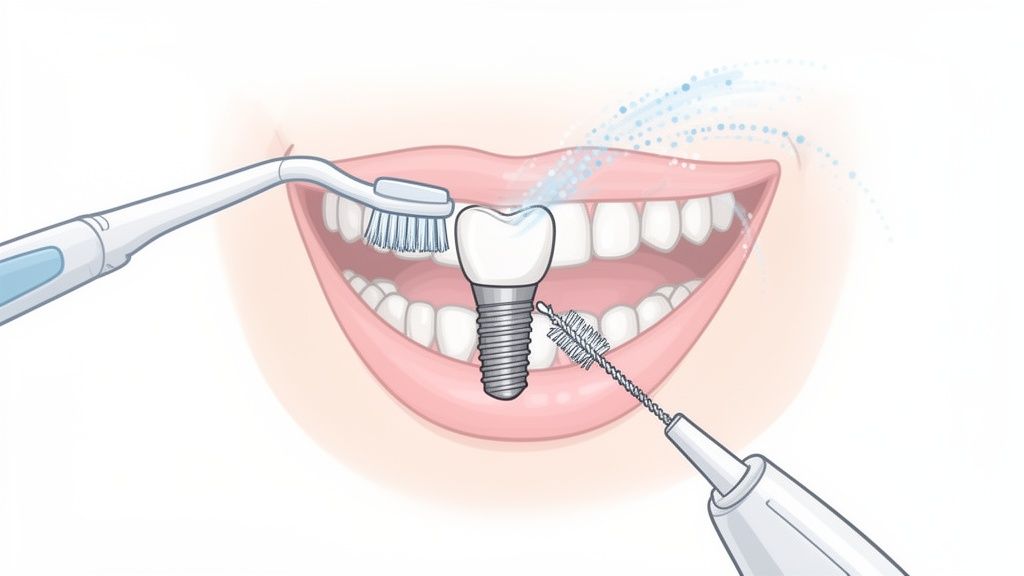
Your new dental implant is built to last a lifetime, but its incredible longevity really comes down to one thing: great aftercare. It’s easy to think of it as a set-and-forget solution, but there's a little more to it. While the implant post and crown can't get a cavity, the surrounding gums and jawbone are living tissues that absolutely need looking after.
The good news is that protecting this investment doesn't mean a massive overhaul of your daily habits. In fact, caring for your implant is surprisingly similar to looking after your natural teeth. Simple, consistent care is all it takes to keep your tooth implant in NZ secure, healthy, and looking fantastic for decades.
Your Daily Maintenance Routine
The secret to a long-lasting implant is a straightforward daily cleaning routine. The whole point is to keep plaque and bacteria from building up around the implant, which can irritate your gums and lead to problems down the track.
Here’s what you need to do:
- Brush Twice a Day: Grab a soft-bristled toothbrush and gently clean all around the implant crown. Make sure to pay extra attention to where the crown meets the gum line—that’s a prime spot for plaque to hide.
- Clean Between Teeth Daily: While traditional floss can work, some specialised tools often get the job done better. Things like an interdental brush or a water flosser are fantastic for cleaning the sides of the implant and the teeth next to it.
This simple routine is your best defence for keeping the surrounding gums and bone healthy, which are the real anchors for your new tooth.
Think of it like this: a house needs a solid foundation to stand strong. In the same way, your implant needs healthy gums and bone to stay secure. Looking after your gums is the single most important thing you can do to ensure your implant goes the distance.
The Importance of Professional Check-ups
Even with the best care at home, there's no substitute for a professional check-up. Regular visits to your dentist and hygienist are a non-negotiable part of your long-term plan. These appointments are our chance to keep a close eye on everything.
During these visits, your hygienist uses special tools to clean around the implant in ways you just can't at home. If you want to know more about what’s involved, you can learn about professional dental hygiene appointments and see how they fit into your overall oral health.
Your dentist will also periodically check that the implant is stable and take x-rays to make sure the bone surrounding it is staying dense and healthy. It's all about being proactive and catching any potential issues long before they turn into real problems, safeguarding the future of your smile.
Choosing the Right Dentist in Lower Hutt

Let’s be honest—finding the right dental professional is probably the single most important decision you'll make on your implant journey. This isn't just about finding someone with the right technical skills. You need a genuine partner in your oral health, someone who listens, explains things in plain English, and helps you feel confident about the path forward.
Thankfully, you've got plenty of options here in the Lower Hutt and Greater Wellington area, so it really pays to know what you’re looking for. A great team won't just place an implant; they’ll guide you through the entire process, making sure you feel informed and in control every step of the way.
Key Questions for Your Consultation
Think of your initial consultation as an interview. You’re interviewing them just as much as they’re assessing your teeth. Don't hold back on asking questions; a true professional will appreciate your diligence. It’s this conversation that will tell you everything about their expertise and patient care philosophy.
Here’s a practical checklist to take with you:
- How many dental implant procedures do you typically perform in a year? Experience matters.
- Could I see some before-and-after photos of your actual patients?
- What kind of technology do you use for planning? (Look for mentions of 3D CBCT scanning).
- Is the whole process handled in-house, from the surgery to fitting the final crown?
Their answers will give you a real sense of their experience level, the quality of their work, and their investment in modern, precise technology.
Finding a clinic that handles everything under one roof—from the initial scans to the final crown placement—can make life so much easier. It just means everyone is on the same page, ensuring your care is seamless from start to finish.
Look for a Partner in Your Health
Ultimately, you want to find a provider who treats you like a person, not just a set of teeth. They should give you clear, transparent information about the procedure, the timeline, and all the costs involved, without any high-pressure sales tactics.
The right dentist is one who genuinely listens to what you want to achieve and addresses your concerns head-on. When you find a clinic where you feel heard, respected, and comfortable, you can move forward with total confidence, knowing you’re in good hands.
Your Questions About Dental Implants in NZ Answered
It's completely normal to have a heap of questions when you're thinking about something as important as a dental implant. After all, you want to be sure you're making the right call. We've put together some straight-up answers to the questions we hear most often from Kiwis looking into a tooth implant in NZ.
Think of this as a conversation starter to clear up any uncertainties and help you feel confident about the path ahead.
Will the Dental Implant Procedure Hurt?
This is usually the first thing people ask, and I'm happy to report the answer is no. We make your comfort our top priority. The whole procedure is done under local anaesthetic, which completely numbs the area, so you won’t feel any pain while we work.
Once the anaesthetic wears off later in the day, you can expect some mild discomfort, much like you'd feel after a standard filling. This is easily handled with everyday pain relief like paracetamol or ibuprofen. We'll send you home with clear, simple instructions to make sure your recovery is as quick and comfortable as possible.
How Long Does a Tooth Implant Actually Last?
Here’s the brilliant part: a dental implant is designed to last a lifetime. This isn't a temporary patch-up job. With good daily care and your regular dental check-ups, you can expect your implant to be a permanent, reliable part of your smile.
The magic behind this incredible durability is a process called osseointegration. It sounds technical, but it’s just the natural way your jawbone grows around and fuses to the titanium implant post. This creates a foundation that’s as solid as a rock, making it a permanent fixture in your jaw—a huge advantage over other options that might need replacing every 5 to 15 years.
This long-term reliability is what makes an implant such a smart investment in your health and confidence.
Can I Claim My Implant on ACC?
Absolutely, there's a good chance you can. If you've lost a tooth because of an accident or injury, the Accident Compensation Corporation (ACC) may cover a large part of your treatment costs. It’s a very common route for New Zealanders who need a tooth implant in NZ following an unexpected mishap.
Your first move is to book a consultation. We can take a look, confirm the tooth was lost due to an accident, and help you get the ACC claim process started. We'll walk you through the paperwork to see exactly what cover you're eligible for, which can make the treatment much more affordable.
How Long Will My Recovery Take?
The recovery happens in two stages. First, there's the initial healing right after the implant is placed. This part is surprisingly fast. Any mild soreness usually fades within a few days, and most people are back to their normal routines pretty much straight away.
The second, more important stage is osseointegration, which takes anywhere from three to six months. You won't feel a thing during this time, but beneath the surface, your jawbone is busy fusing with the implant. Being patient here is key, as this is what locks in the lifelong stability of your new tooth.
Ready to explore your options and get your full smile back? The friendly team at Switch Dental is here to answer any other questions you might have. Book your consultation online today and let’s work out a plan to restore your smile and confidence.