Dental Implants vs. Dentures: Why More Patients Are Switching to Implants
Losing a tooth is more common than many people realise, and the decisions that follow can feel overwhelming. Should you replace it with a denture, or is a dental implant the better long-term investment in your smile? At Switch Dental in Lower Hutt, we see patients every week who are weighing up exactly this question. This article explores both options honestly, using only what our own clinical experience and services tell us, so you can have an informed conversation with your dentist about what is right for you.
Understanding the Real Impact of a Missing Tooth
When a tooth is lost, the effects go far beyond the visible gap. As we explain to our patients, it’s what happens beneath the surface that really matters. Think of a tooth like a fence post: remove it, and the surrounding structure can start to weaken.
- Neighbouring teeth can shift or tip into the empty space.
- The opposing tooth (in the other jaw) may over-erupt, since it no longer meets resistance.
- The jawbone beneath the gap can begin to shrink over time, since it no longer receives the stimulation a tooth root provides.
Teeth work together as a team. When one is missing, the rest of the “team” starts compensating, which can lead to further complications down the track. This is exactly why choosing the right replacement option matters so much, and why so many patients are now leaning toward dental implants over traditional dentures.
What Are Dental Implants?
Dental implants are one of the most effective ways to restore both the appearance and function of a missing tooth, rebuilding the smile from the ground up. At Switch Dental, we place and restore implants in-house, using digitally guided surgery and modern technology to make the process as precise and comfortable as possible.
The Planning Process: Precision from the Start
We like to compare implant planning to building a house. Before construction begins, you would survey the land, check the soil, and plan a solid foundation. We take the same approach with dental implants:
- 3D CBCT scans are used to map your jaw’s bone density and shape, giving us a clear picture of what we are working with beneath the gum line.
- The TRIOS scanner captures a clean digital impression of your bite, without the need for messy traditional moulds.
- This digital information allows us to plan the implant placement carefully before any procedure begins, reducing surprises and improving accuracy.
This level of preparation is a key reason patients are increasingly choosing implants: the process is methodical, transparent, and built on real data about your own mouth, rather than a one-size-fits-all approach.
Why Patients Are Switching to Implants
While every patient’s situation is different, there are several reasons implants have become a preferred option for many people replacing missing teeth:
- They address the root of the problem, not just the gap. Because an implant replaces the tooth root itself, it provides the kind of stimulation to the jawbone that a denture simply cannot.
- They are designed to function like a natural tooth. Since implants are fixed in place, they avoid the shifting or movement that can sometimes be a concern with removable options.
- They support neighbouring teeth. Because implants restore a stable single tooth (or teeth), they help prevent the domino effect of shifting, tipping, or over-eruption that can occur when a gap is left unaddressed or replaced in other ways.
- The process is precise and in-house. At Switch Dental, the entire journey, from 3D scanning to placement and restoration, happens under one roof, allowing our team to maintain consistency and control over your care.
What Are Dentures, and Where Do They Fit In?
Dentures have long been one of the most accessible ways to replace missing teeth, and for many people, they remain a genuinely practical option. At Switch Dental, we approach dentures with honesty and clarity, because we believe patients deserve straightforward information, not a sales pitch.
A well-made denture can restore both appearance and function. However, as we tell our patients directly, dentures are not the same as natural teeth or implants, and we won’t sugar-coat that. They come with trade-offs that are worth understanding before making a decision.
Types of Dentures We Offer
- Full dentures, for patients who need to replace an entire arch of teeth.
- Partial dentures, for patients who still have some natural teeth remaining.
- Replacement or relined dentures, for patients revisiting an older denture that no longer fits well.
Our team uses modern techniques, including digital scans where appropriate, to design dentures that fit both your mouth and your lifestyle. We guide patients through every step of the process clearly, without upselling or unnecessary jargon.
When Dentures Might Be the Right Choice
Dentures can be an effective and cost-conscious solution when they are planned carefully and maintained well. For some patients, particularly those replacing multiple or all teeth, dentures remain a sensible and accessible starting point. The key is going in with realistic expectations and working with a team that will guide you honestly, as we do at Switch Dental.
Dental Implants vs. Dentures: A Side-by-Side Look
Stability and Function
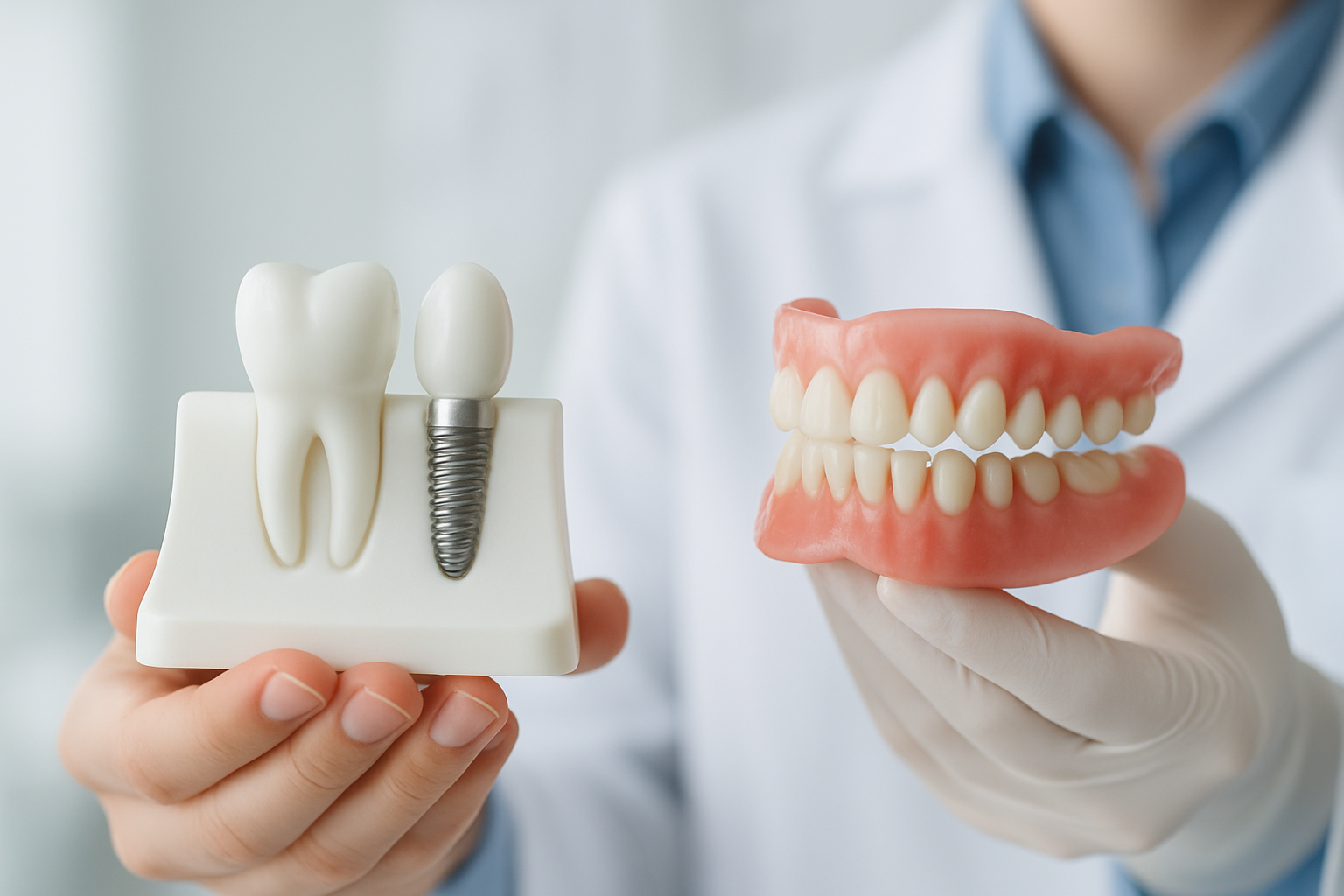
Dental implants are fixed into the jawbone, functioning much like a natural tooth root. Dentures, being removable, rely on the gums and remaining ridge of bone for support and retention. For patients who want a solution that feels most like their natural teeth in day-to-day use, this is often the deciding factor in choosing implants.
Bone Health Over Time
One of the most important, and often overlooked, differences between the two options is what happens to the jawbone over time. Because an implant replaces the tooth root, it helps maintain stimulation to the bone in that area. Dentures sit on top of the gum and do not provide the same kind of support to the underlying bone structure.
Impact on Neighbouring Teeth
As outlined earlier, a missing tooth can cause neighbouring teeth to shift, tip, or take on extra load, much like players compensating for a missing teammate. Implants are designed to restore that missing “player” in a fixed, stable way, which can help protect the surrounding teeth from this kind of overload.
The Planning and Fitting Process
Implants at Switch Dental involve a detailed digital planning process, including 3D CBCT scans and TRIOS digital impressions, before any surgical work begins. Dentures also benefit from modern digital scanning technology where appropriate, but the end result is a removable appliance rather than a fixed restoration.
Making the Right Choice for Your Smile
There is no single “correct” answer when it comes to dental implants versus dentures. The right choice depends on your oral health, the number of teeth involved, your bone density, your lifestyle, and your personal priorities. What matters most is having an honest conversation with a dental team who will explain your options clearly, without pressure.
At Switch Dental in Lower Hutt, we are committed to that kind of transparency. Whether we are discussing dental implants, dentures, or another treatment entirely, our goal is always to help you understand the trade-offs so you can make a decision that suits your health and your life.
Other Factors That May Influence Your Decision
- The condition of your remaining teeth. If you have several healthy teeth remaining, a partial denture or a single implant may be considered, depending on your circumstances.
- Your bone density. This is assessed through 3D CBCT scans when implants are being considered, since adequate bone is an important part of implant planning.
- Your daily routine and comfort preferences. Some patients prioritise a fixed solution, while others are comfortable with a removable option, particularly when cost and simplicity are key considerations.
- Related dental issues.