
When a tooth comes out, the story doesn’t end there. The bone that once held it in place starts to shrink away — a natural process called bone resorption. You won’t notice it straight away, but over months and years the jaw slowly remodels: neighbouring teeth can drift, your bite can change, and the shape of your smile and face can subtly shift.
That’s where socket preservation comes in. It’s a simple step done at the same time as an extraction, placing a graft material into the socket so your body has a scaffold to build new bone around. Think of it like landscaping before building a house: if you want strong foundations for whatever comes next — an implant, bridge, or even just to hold the gum contour in place — it pays to prepare the ground properly.

- Bone shrinkage begins as soon as the tooth is gone.
- In the first 6–12 months, a lot of the bone volume disappears.
- The gum may close over in 6 weeks, but deep inside the bone is still remodelling.
- Teeth that once stood shoulder-to-shoulder can start tipping or shifting into the space.
None of this is “life-or-death urgent,” but if you’re considering replacing the tooth down the track, having more bone now means fewer problems later.
At Switch Dental we commonly use Ossix® grafting material — it acts like a scaffold, allowing your own bone to grow into the space. There are other graft options too (synthetic or human-derived), and we’ll explain them fully before treatment.
The graft is placed gently into the empty socket after the tooth is removed, then covered and left to heal. Over 3–6 months, your body slowly replaces it with your own bone. It doesn’t feel any different from a standard extraction.
If you decide later that you’d like an implant, the groundwork is already done. If you don’t, you’ve still preserved bone volume and kept your options open.
Socket preservation helps:
- Maintain jawbone volume – reducing collapse or shrinkage
- Support neighbouring teeth – so they don’t tip or drift
- Keep facial shape natural – especially important for front teeth
- Make future implants easier – no need for extra surgery later
- Preserve your choices – even if you’re not sure yet what you want
Without it, a future bone graft can still be done — but it usually means another surgical procedure, sometimes with a specialist referral.
Is socket preservation always necessary?
Not always. But if you’re thinking about a future implant, or the tooth is in a visible area, it’s usually a smart option.
Does it hurt?
No — it’s done under the same local anaesthetic as your extraction. Afterwards, it feels like a normal healing socket.
How long does it take to heal?
Initial gum healing: ~6 weeks. Full bone maturation: 3 months.
What if I’m not sure if I want an implant yet?
That’s actually the perfect time to graft. It keeps the door open without locking you into anything.

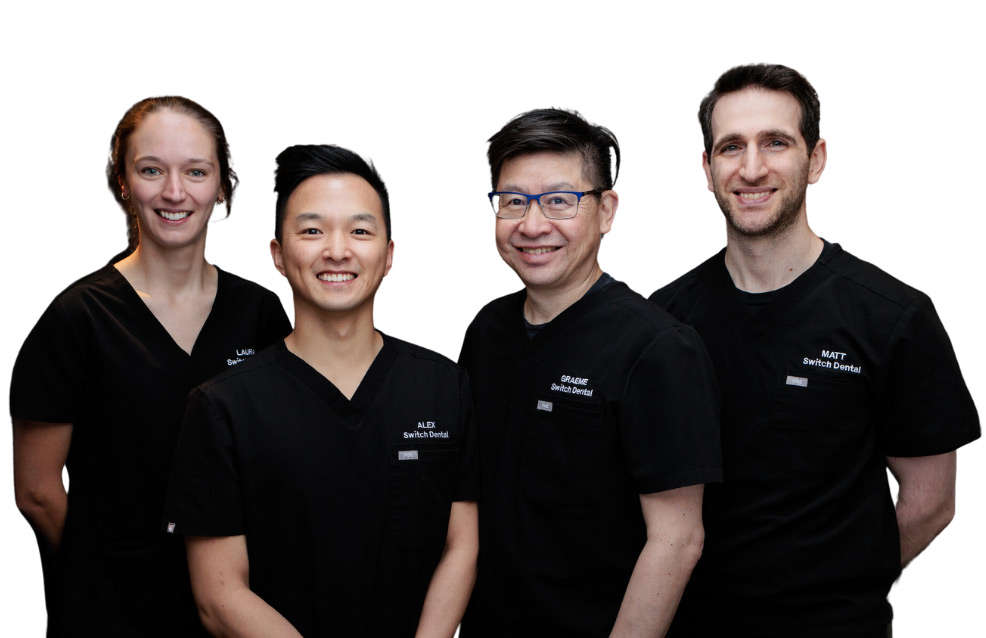
Why Switch Dental?
Hospital-trained dentists with surgical experience
Digital imaging (3D scans, CBCT when needed) to plan precisely
Evidence-based materials with proven long-term results
Friendly, straight-up advice about whether it’s worth doing in your specific case