
Sometimes it’s the small things that make the biggest difference. If your bite feels a little off, it can slowly start affecting everything — from how your teeth wear down to how your jaw feels. At Switch Dental in Lower Hutt, we use modern diagnostic tools, including TRIOS digital scanning and articulating paper, to detect where your bite isn’t quite right — and then gently make precise refinements to bring it back into harmony.
Most of the time, your teeth should meet evenly and comfortably when you close your mouth — no awkward pressure, no one tooth hitting first, no tension in the jaw. But even small misalignments can add up over time, sometimes without you realising it. That vague sensitivity when chewing, your jaw clicking or popping, or headaches in the morning? It could be your bite.
An unbalanced bite (malocclusion) can cause:
- Worn or chipped teeth
- Sore or loose teeth from uneven force
- Jaw discomfort, clicking, or restricted movement
- Facial muscle strain and tension headaches
- Aggravated clenching or grinding (parafunction)
Sometimes, patients come in thinking something is wrong with a tooth — but it’s actually the way the teeth come together that’s causing the issue. A carefully done occlusal adjustment can bring a surprising amount of relief.
This isn’t about grinding down your teeth — it’s about removing microscopic amounts of enamel (we’re talking fractions of millimetres) in specific spots to let your bite come together smoothly.
Here’s how we approach it at Switch:
- We begin with a detailed bite assessment, including a TRIOS scan or bite registration to create a digital model of your bite. We use articulating paper to highlight which parts are hitting first, and assess how your muscles and joints are responding — including checking your masseters and overall jaw movement.
- We explain what we find and why it matters. We’ll walk you through the contact points and any evidence of strain, so you’re not left wondering what’s happening.
- The actual adjustment is extremely conservative. Your dentist will gently smooth any high spots using fine polishing tools. We’ll test, recheck, and fine-tune until everything feels balanced again.
No numbing is usually needed, and most people describe the sensation more as “weird” than uncomfortable. You might feel immediate relief — or simply notice over time that the discomfort you had starts to fade.
Is it painful?
Not at all. Because we’re only reshaping the enamel (which has no nerves), no anaesthetic is usually needed. You’ll feel pressure or vibration but no pain.
How long does it take?
Often just one appointment. If your case is more complex, or if we’re coordinating with other treatments, it may take a couple of sessions to get things just right.
Will my bite feel different?
Possibly — and in a good way. Many patients say things “just feel more natural” afterwards. You may notice less tension or better chewing function.
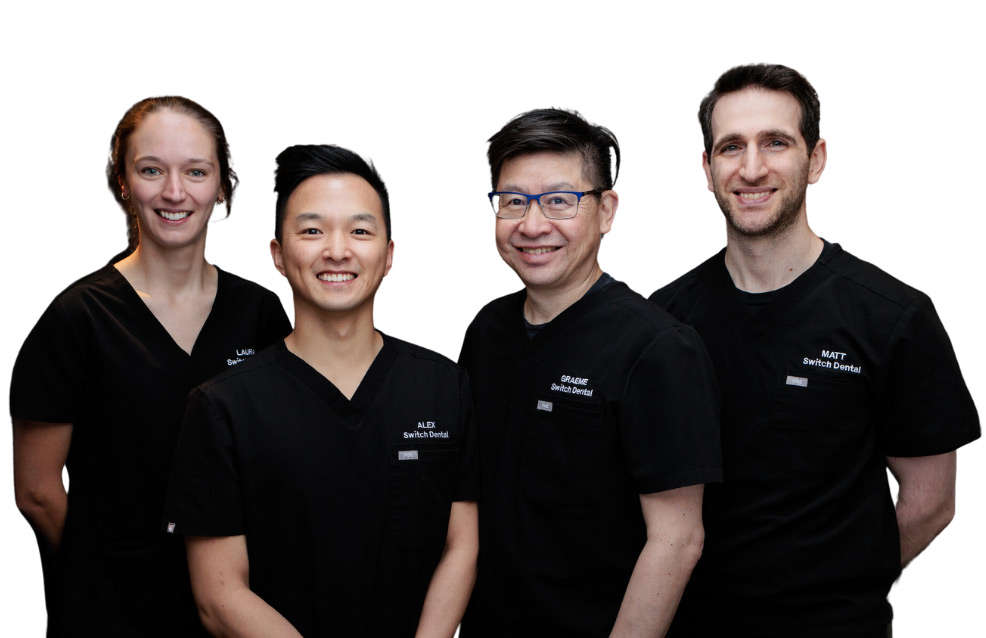
Why Choose Switch Dental?
Our occlusal adjustments are part of a bigger picture — not just symptom relief, but long-term stability and comfort. You’ll benefit from:
- Accurate digital diagnosis using TRIOS technology and articulating systems
- Dentists with a fine-tuned feel for occlusion, who understand how even small tweaks can make a big impact
- A collaborative team that may include follow-up with a nightguard, Invisalign, or Botox for parafunction — all discussed openly and without pressure
- Clear communication about what we’re doing and why — no dental jargon or “just trust us” vibes
- Integrated treatment if you’re also having cosmetic, orthodontic, or restorative work done — so your bite supports your whole mouth, not just the problem area
We also assess whether ongoing clenching or grinding (parafunction) is part of the picture — and may discuss additional strategies like custom nightguards or masseter Botox treatment (link placeholder) to help protect your bite from future stress.